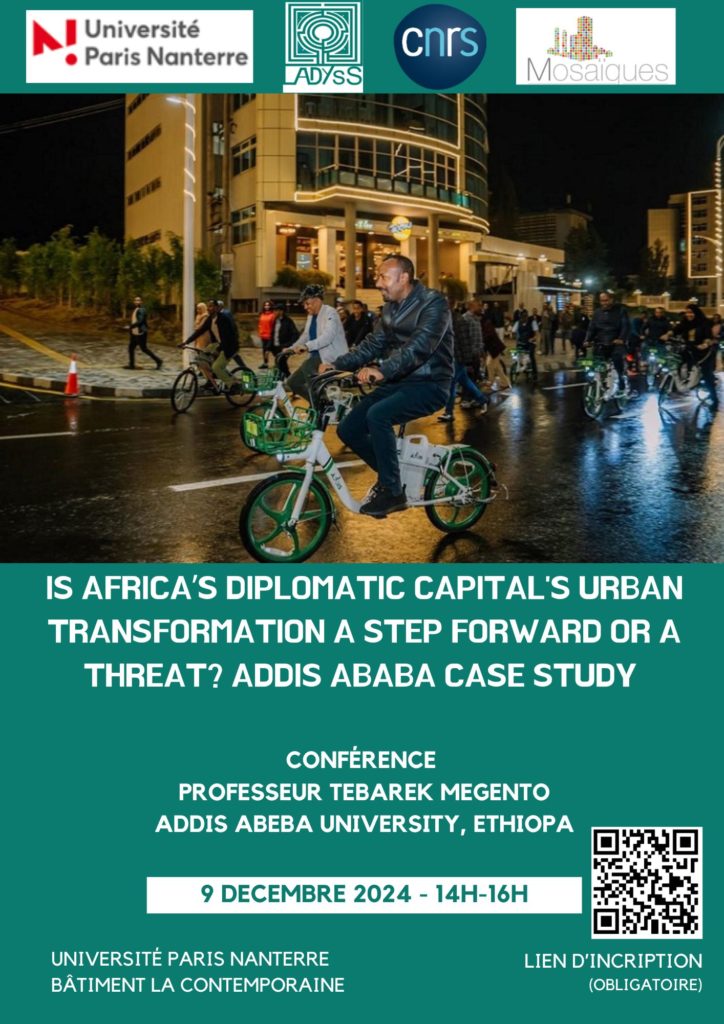
Conférence de T. MEGENTO (Addis Abeba University, Ethiopia) « Is Africa’s Diplomatic Capital’s Urban Transformation a Step Forward or a Threat ? Addis Ababa case study
Lundi 9 décembre 2024, 14h-16h, Université Paris-Nanterre, Bâtiment La Contemporaine (sur inscription obligatoire)
Is Africa’s diplomatic capital’s urban transformation a step forward or a threat ?
By professor Tebarek Megento (Addis Ababa University, Ethiopy)
Ethiopia, a country facing internal conflict and geopolitical tensions, has been implementing large-scale urban renewal programs since the early 1990s. This transformation is particularly noticeable in Addis Ababa, where changes have been driven by a neoliberal governance framework. However, critics argue that these initiatives can lead to negative consequences, such as the displacement, dislocation, and eviction of residents and businesses. The recent development of corridors in Addis Ababa necessitates a thorough analysis of its social, economic, and environmental implications, as these projects often impose significant costs on local businesses and residents. Urban renewal schemes, including the Corridor projects, tend to prioritize progress over social equity, which threatens cultural assets, livelihoods and environmental health and underscores the need to strike a balance between modernity and preservation. Moreover, the city’s focus on aesthetics rather than functionality raises important questions about the sustainability of these projects.